irregular algorithms
See irregular for the input/output format and CLI usage of this solver.
Trivial single item
This algorithm solves the feasibility objective.
This is not an algorithm aimed at generating real patterns. It is aimed at providing a fast debug routine to check if an item fits in at least one bin.
It tries to place the item by aligning the center of its bounding box with the center of the bin’s bounding box, then validates (and, if needed, adjusts) the placement against the bin’s actual shape.
Tree search
This algorithm solves the feasibility, knapsack, bin-packing, bin-packing-with-leftovers, open-dimension-x, open-dimension-y objectives.
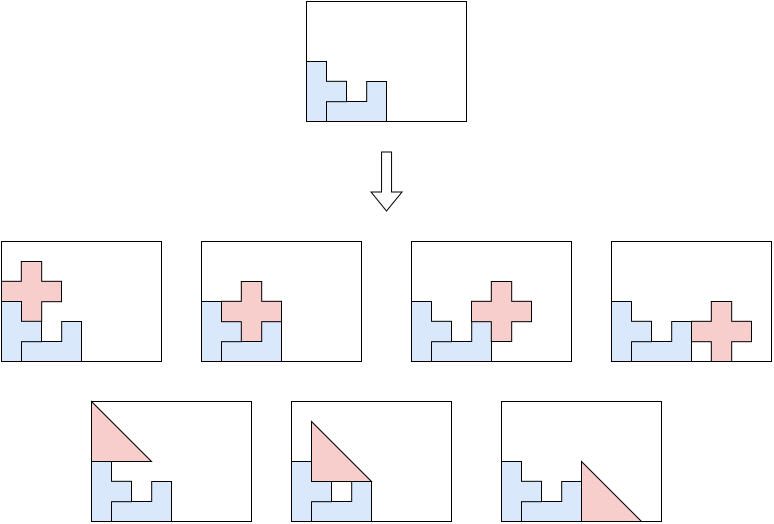
It is a tree search algorithm where a single item is packed at each stage. The root node is an empty partial solution (no item packed). Given a node, a child node is generated for each feasible insertion of each unpacked item.
It is a generalization of the tree search algorithm for rectangle.
MILP raster
This algorithm solves the feasibility and knapsack objectives.
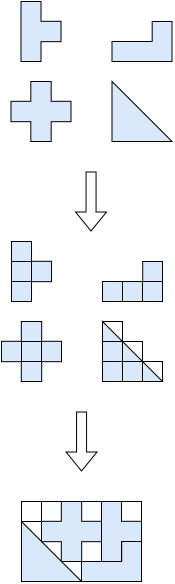
It rasterizes the bin and items onto a grid and solves the resulting placement problem as a mixed-integer linear program.
Input:
a set \(G\) of grid cells
a set \(P\) of candidate placements; for each placement \(p\), an item type \(j(p)\), a profit \(p_{j(p)}\) and the set of cells \(C_p \subseteq G\) it covers
item types \(j = 1, \ldots, n\); for each item type \(j\), a number of copies \(q_j\)
Variables:
\(x_p \in \{0, 1\}\), \(p \in P\): \(x_p = 1\) iff placement \(p\) is selected
Objective: maximize the total profit of the placed items
Constraints:
Item copies: each item type is placed at most (
knapsack) or exactly (feasibility) its number of copies
Cell conflict: each grid cell is covered by at most one placement
The algorithm starts with a coarse grid and iteratively halves the cell size, re-solving the model each time, until the time limit is reached.
Local search
This algorithm solves the feasibility objective.
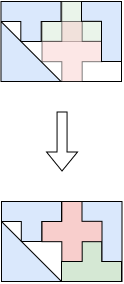
It works on a solution where all items are packed with overlap. At each iteration, it tries to reduce the overlap until no items overlap anymore and the solution becomes feasible.
One-dimensional bound
This algorithm computes a bound for the bin-packing, knapsack and variable-sized-bin-packing objectives.
Relaxes the instance to a one-dimensional problem (each bin and item type keeps only its area) and solves it, which is much cheaper than solving the irregular problem itself. The resulting bin-packing / knapsack / variable-sized-bin-packing bound is a valid bound for the original instance, since no irregular packing can use less total area than this relaxation requires.